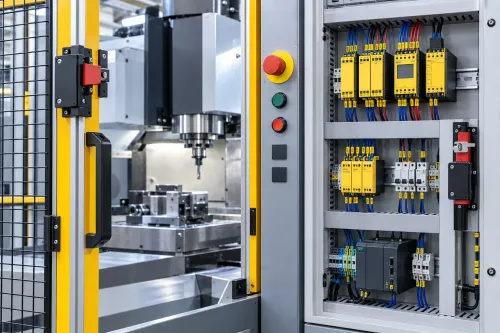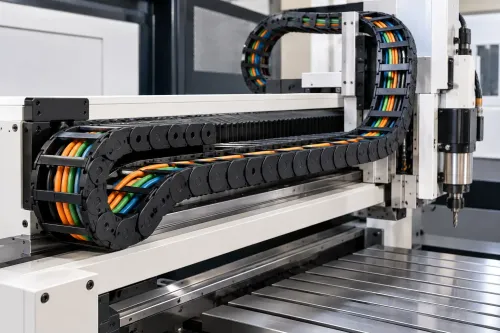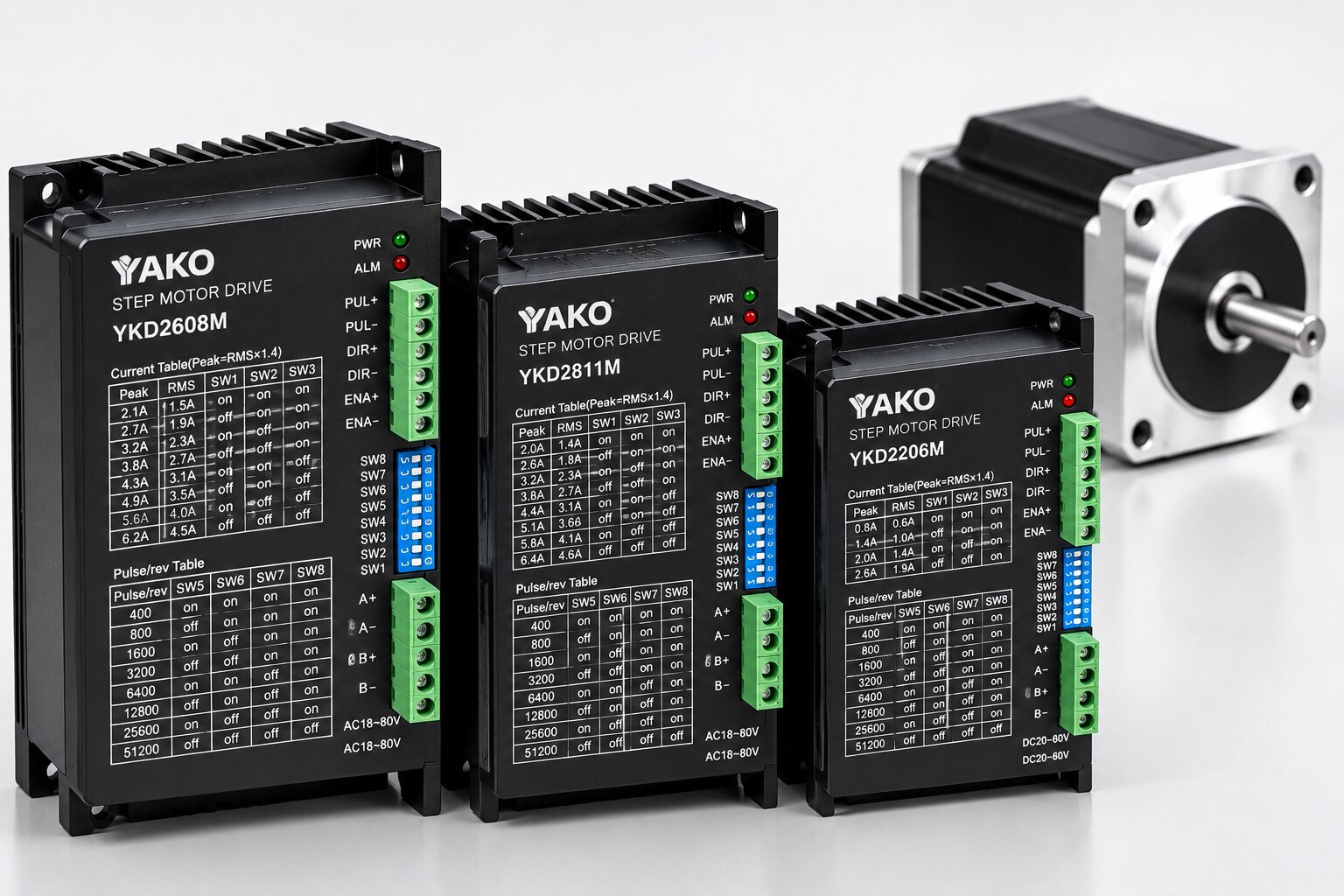
A Yako stepper drive can suit a machine-tool axis, but only when the motor, ballscrew, controller, load and duty cycle are matched as one system. By the end, you will be able to separate suitable low-speed positioning jobs from axes that require closed-loop stepper control or a servo, and prepare the checks needed before approving a drive.
Key takeaways
- Use open-loop drives for auxiliary axes where missed steps do not cause damage.
- Size the complete axis from load torque, speed, acceleration and duty cycle.
- Match motor current, supply voltage, controller pulses and drive input type.
- Choose closed-loop control or Yako servo when position loss threatens the process.
Which machine-tool axes suit an open-loop Yako stepper drive?
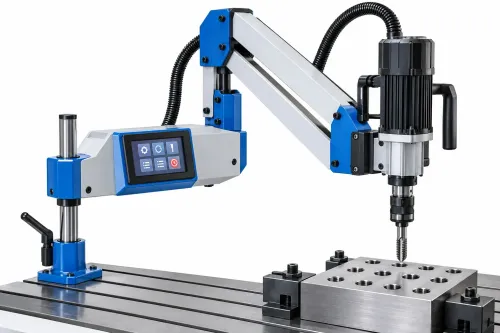
An open-loop Yako stepper drive suits a machine-tool axis when missed steps will not create a dangerous or costly result. A stepper drive for machine builders fits drilling slides, feeders, clamps, tool-changing mechanisms, coolant positioning and lightly loaded auxiliary slides better than cutting axes.
| Axis or mechanism | Suitability | Reason |
|---|---|---|
| Drilling slide, feeder or clamp | Suitable after testing | Moderate speed, predictable load and limited disturbance |
| Tool changer, coolant positioner or auxiliary slide | Suitable after testing | Positioning duty outweighs contouring performance |
| CNC lathe feed or milling table | Risky | Cutting load, vibration, inertia and peak-speed demands can cause lost steps |
Reject open-loop control when the axis needs continuous near-zero-speed torque, rapid acceleration, high peak speed, high reflected inertia, strong disturbance rejection or verified following-error control. A lost step can leave the controller reporting the commanded position while the mechanism sits elsewhere.
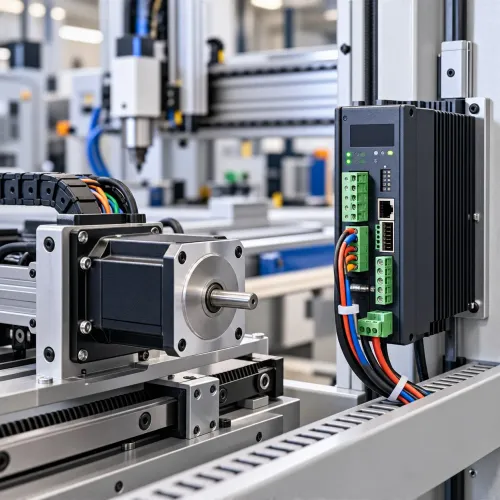
Select a Yako stepper drive for machine tool builders in Coimbatore as a matched motor-drive pair. Check the motor’s phase current, winding inductance, supply voltage, required speed and torque-speed curve; the drive’s maximum current alone proves nothing.
A 24–80 VDC drive requires a correctly rated AC/DC supply, protective devices, earthing, isolation and cabinet distribution. Never connect it directly to a typical machine-tool mains incomer. Size the supply for acceleration current, simultaneous-axis duty, voltage sag and energy returned during deceleration.
How do you size the motor and drive around the complete axis?
Calculate torque at the screw, not from motor frame size or holding torque alone. Convert cutting force to screw torque with T = F × lead ÷ (2π × efficiency), then add friction torque and acceleration torque from axis mass, acceleration and reflected rotary inertia.
Reflect motor, coupling, belt and screw inertia through the transmission; a high-inertia load can demand far more acceleration torque than its static weight suggests.
| Factor | Check | Consequence if ignored |
|---|---|---|
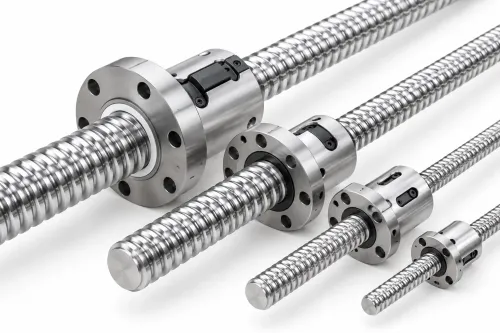
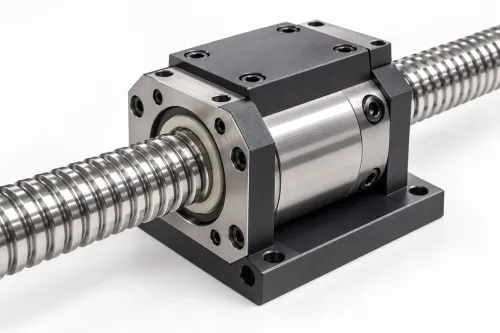
| Ballscrew lead and preload | Compare lead, efficiency and preload torque; include Hiwin-type screw and linear-guide friction | A low-lead screw improves force but reduces speed; preload raises starting torque and affects repeatability |
| Transmission | Include belt ratio, coupling stiffness and backlash | Flex delays response; backlash corrupts reversal accuracy |
| Operating point | Read the motor speed-torque curve at actual DC-bus voltage and commanded speed | Torque falls with speed, and resonance can cause lost steps |
| Cutting duty | Add cutting-force changes, acceleration peaks and holding time | A brief overload can stall an axis that appears adequate at idle |
Approve the pair only with torque margin at the worst point, not at rated holding torque. Check the selected stepper drive for winding inductance, phase current and voltage compatibility. Microstepping improves smoothness and noise, but it does not create proportional torque or guaranteed positioning accuracy.
- Calculate RMS phase current over the duty cycle, including holding time; test motor temperature with its intended mounting, ambient temperature and cabinet cooling.
- Size the DC supply for acceleration current, simultaneous-axis duty, voltage sag and deceleration energy returned to the bus.
- Run loaded-axis acceleration, reversal, resonance, repeatability and worst-case cutting tests at the commanded microstep setting.
What must match between the drive, power supply and machine controller?
Approve a YAKOTEC stepper drive only after the exact drive, motor, power supply and controller are checked as one system. Brand-level compatibility is not evidence: an unsuitable pulse level or timing can make a PLC miss commands.
Obtain these details from the model manual and controller datasheet:
1. Confirm the drive’s two-phase or other phase configuration, rated and peak output current, 24–80 VDC input range, motor-wiring requirements, maximum pulse frequency, microstep or subdivision settings, encoder compatibility, alarm outputs, protection functions and braking arrangements.
2. Match the controller’s step-and-direction or pulse-and-direction output to the drive. Check single-ended or differential signals, signal voltage, line-driver compatibility, minimum pulse width, direction setup time, electrical isolation, enable input, alarm reset and emergency-stop logic.
3. Size the AC/DC supply for acceleration current and simultaneous-axis duty, not motor wattage alone. Verify voltage sag, fuse and breaker coordination, earthing, isolation and returned energy during deceleration; never connect a 24–80 VDC drive directly to the machine’s mains incomer.
4. Prove command reliability at the highest commanded speed. Test pulse counts, direction reversal, enable, alarm reset and emergency stop, then record motor current and drive faults.
Treat EMC as a system property under IEC 61800-3. Bond the cabinet, terminate shields correctly, route motor cables away from encoder and limit-switch wiring, and control cable length and grounding. Approve the combination only from model-specific documentation and a loaded-axis test.
When should you choose closed-loop stepper control or Yako servo for machine tools?
Choose closed-loop stepper control when a moderate-speed axis needs position-error detection or correction but does not demand servo-level dynamic response. An open-loop stepper can lose synchronism during excessive acceleration, resonance, inadequate voltage, insufficient current, high inertia or a sudden cutting load, while the controller reports no conventional position alarm.
| Option | What it provides | When it applies |
|---|---|---|
| Open-loop stepper | Low complexity, but missed steps remain undetected | Feeders, clamps and auxiliary slides after loaded validation |
| Closed-loop stepper | Encoder-based position-error detection or correction | Moderate-speed axes where some feedback is justified |
| Yako servo for machine tools | Encoder or resolver feedback, tuning, following-error limits and stronger disturbance response | High-speed cutting axes or any axis needing verified tracking |
Validate the complete axis at the intended microstep setting:
- Home repeatedly, command repeated moves and test reversals in both directions.
- Test acceleration and deceleration at production loads, then run loaded cutting trials.
- Record static accuracy, repeatability and contouring performance; microstepping improves smoothness but does not guarantee proportional torque or positioning accuracy.
- Specify encoder or resolver feedback, tuning provisions, braking, regenerative-energy handling and following-error limits for a Yako servo for machine tools.
- If an undetected error could cause a crash, tool damage or scrap, require feedback, independent overtravel protection and a risk-assessed safety architecture under ISO 12100 and ISO 13849-1 where applicable. Do not rely on software pulse disabling alone for emergency stops or protective doors.
What should you demand from a Yako stepper drive supplier in Coimbatore?
Treat a catalogue listing as unapproved until a Yako stepper drive supplier in Coimbatore provides an acceptance package tied to your machine-tool bill of materials.
1. Request the exact drive and motor part numbers, motor torque-speed curve, phase current, winding inductance, supply range, wiring diagram, I/O electrical levels, pulse-direction interface details, parameter backup and protection settings. Brand-level compatibility is not enough.
2. Require a matched motor-drive recommendation based on the actual load, speed and bus voltage, not the drive’s maximum current. Obtain replacement lead time, warranty terms and named commissioning support. SSB INDUSTRIAL SOLUTIONS is useful here when it supplies this model-specific evidence and helps test the complete axis.
3. Commission the loaded axis at worst-case duty. Record motor and drive temperatures, RMS phase current, acceleration, holding time, cabinet ambient temperature and cooling performance; confirm fuse and breaker coordination, protective earthing, isolation and motor-cable EMC practices.
4. Record homing position, repeated moves, reversal results and repeatability under load. Check controller commands at operating pulse rates, then test that an emergency stop or door opening prevents automatic restart until a deliberate reset and safe re-enable sequence occur.
5. Approve an open-loop stepper only for a validated low-speed auxiliary or positioning axis. Specify encoder-equipped closed-loop control or a servo when missed position could damage the machine, tooling or product; add independent overtravel protection and a risk-assessed safety architecture.
Related product
 | Yako stepper and drive Yakotec servo Stepper motor with drive stepper motor with brake servo motor and drive 2ph stepper motor yako drive View product → |
Frequently asked questions
Which machine-tool axes suit an open-loop Yako stepper drive?
Use it for drilling slides, feeders, clamps, tool-changing mechanisms, coolant positioning and lightly loaded auxiliary slides. Avoid cutting axes when missed steps could scrap a part, damage tooling or create a hazard.
How do you size a Yako stepper drive and motor around the complete axis?
Calculate force or torque from the payload, guides, screw lead, friction and acceleration. Check the motor’s torque-speed curve at the required speed, then verify drive current, microstep settings, duty cycle and thermal limits.
What must match between the drive, power supply and machine controller?
Match the motor phase current and wiring to the drive, keep supply voltage within the drive’s stated range, and confirm the controller’s pulse, direction, enable, voltage and input-frequency specifications.
When should you choose closed-loop stepper control or Yako servo for machine tools?
Choose closed-loop stepper control when load variation or occasional position loss needs detection. Choose Yako servo for high speed, rapid acceleration, continuous contouring, tight positioning or axes where a missed step could cause costly damage.
What should you demand from a Yako stepper drive supplier in Coimbatore?
Ask for the exact model datasheet, motor compatibility, current and voltage limits, pulse-input specifications, wiring diagram, alarm details, warranty terms, commissioning support and replacement availability.
Keywords