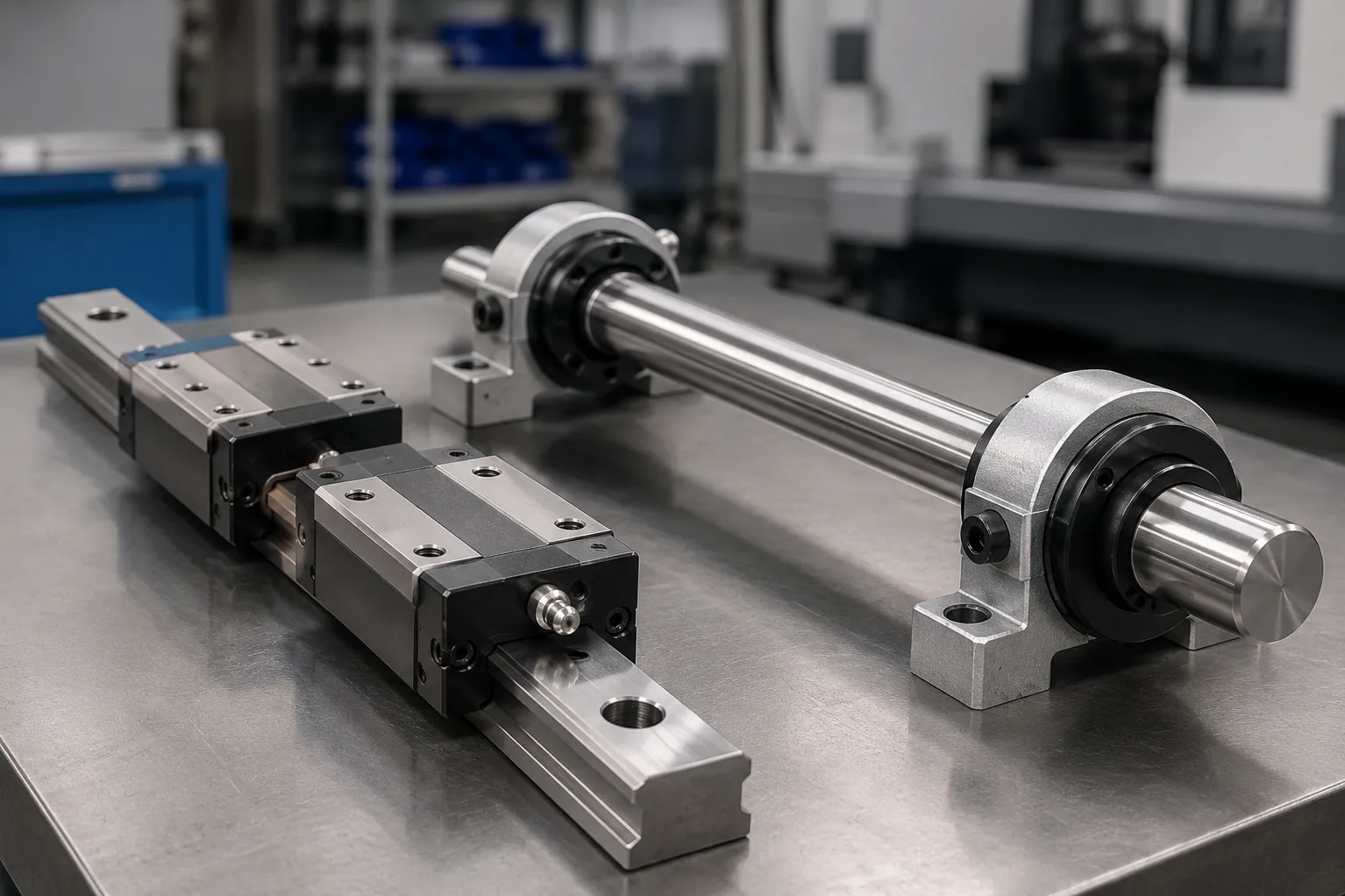
Selecting a linear guidance system often comes down to two practical approaches: profile rail guideways or round-shaft bearing systems. Both can provide linear movement, but their mechanical characteristics and ideal applications differ.
For equipment manufacturers evaluating LM Guideways for Industrial Machinery, understanding these differences can prevent both under-specification and unnecessary expenditure.
How the Two Systems Differ
An LM guideway generally uses a profiled rail with recirculating runner blocks. A round-shaft system uses linear bearings travelling on cylindrical shafts.
Both reduce friction and guide movement, but they respond differently to loads, structural demands and installation conditions.
LM guideways can be useful where:
- Higher rigidity is required
- Moment loads need to be controlled
- Compact installation is important
- Consistent positioning is necessary
- Machine loads are relatively demanding
Round-shaft systems may suit applications where:
- Mechanical simplicity is valuable
- Loads are moderate
- Installation flexibility is required
- The motion arrangement is relatively straightforward
- Cost and ease of integration are important considerations
The application should determine the choice.
Compare Rigidity Before Price
Component price alone does not provide a meaningful comparison.
A system that costs less initially but deflects excessively under the actual machine load can affect production quality and eventually require redesign.
Profile guideways can provide substantial rigidity within a compact arrangement when properly sized and installed. Round shafts, particularly unsupported configurations, can be more susceptible to deflection as span and load increase.
Supported shaft systems can address some of these limitations, making them worth evaluating before assuming an LM rail is always required.
Installation Requirements Are Different
Profile rails typically require accurately prepared mounting surfaces and careful alignment.
If two rails are used in parallel, installation errors can introduce unwanted internal loading.
Round-shaft systems can offer different mounting possibilities, but parallelism and bearing alignment remain important.
For machine manufacturers in Coimbatore, the available machining capability for the base structure should therefore form part of the selection decision.
Specifying a sophisticated guideway without providing a suitable mounting surface limits the benefit of the component.
Consider the Machine's Load Pattern
A centrally applied vertical load is only one scenario.
Machine carriages can experience forces from machining, actuators, tooling, acceleration and offset payloads. These forces can create pitch, yaw and roll moments.
LM Guideways for Industrial Machinery are often considered when resistance to these combined loads and moments is important.
The number and spacing of rails and blocks also influence system rigidity.
Maintenance and Operating Environment
Both systems require attention to lubrication and contamination.
Textile, machining and general engineering facilities across Coimbatore and Tamil Nadu may expose motion components to lint, dust, chips, coolant or other process contaminants.
Protective measures can include seals, scrapers, covers and appropriate lubrication practices.
A technically capable motion system can still experience shortened service life when environmental protection is inadequate.
Making the Final Selection
Before choosing between LM guideways and round shafts, compare:
- Load magnitude and direction
- Moment loads
- Required rigidity
- Travel length
- Speed and acceleration
- Accuracy and repeatability
- Available installation space
- Mounting surface quality
- Environmental conditions
- Maintenance requirements
SSB Industrial Solutions supports industrial engineering and procurement requirements in Coimbatore where the decision involves matching linear-motion components to machine operating conditions.
The right solution is not necessarily the most sophisticated option. It is the one that delivers the required rigidity, movement quality and serviceability within the machine's technical and commercial constraints.
For new machinery, evaluating these factors during design is considerably easier than correcting an unsuitable guidance arrangement after fabrication and assembly have been completed.
Keywords