A reseller must weigh faster assembly and easier modification against lower damping, higher hardware count and the risk of an under-stiff frame. By the end, you will have a practical way to compare aluminium with welded steel, size the structure, specify compatible hardware and judge whether local sourcing improves delivery and after-sales work.
Key takeaways
- Choose aluminium extrusion when frequent changes outweigh maximum frame stiffness.
- Size profiles by load, span, deflection and motion accuracy—not load rating alone.
- Use matched T-nuts, brackets and internal connectors to prevent joint slip.
- Qualify suppliers on profile compatibility, cut accuracy, stock and technical support.
When do aluminium strut profiles beat welded steel frames?
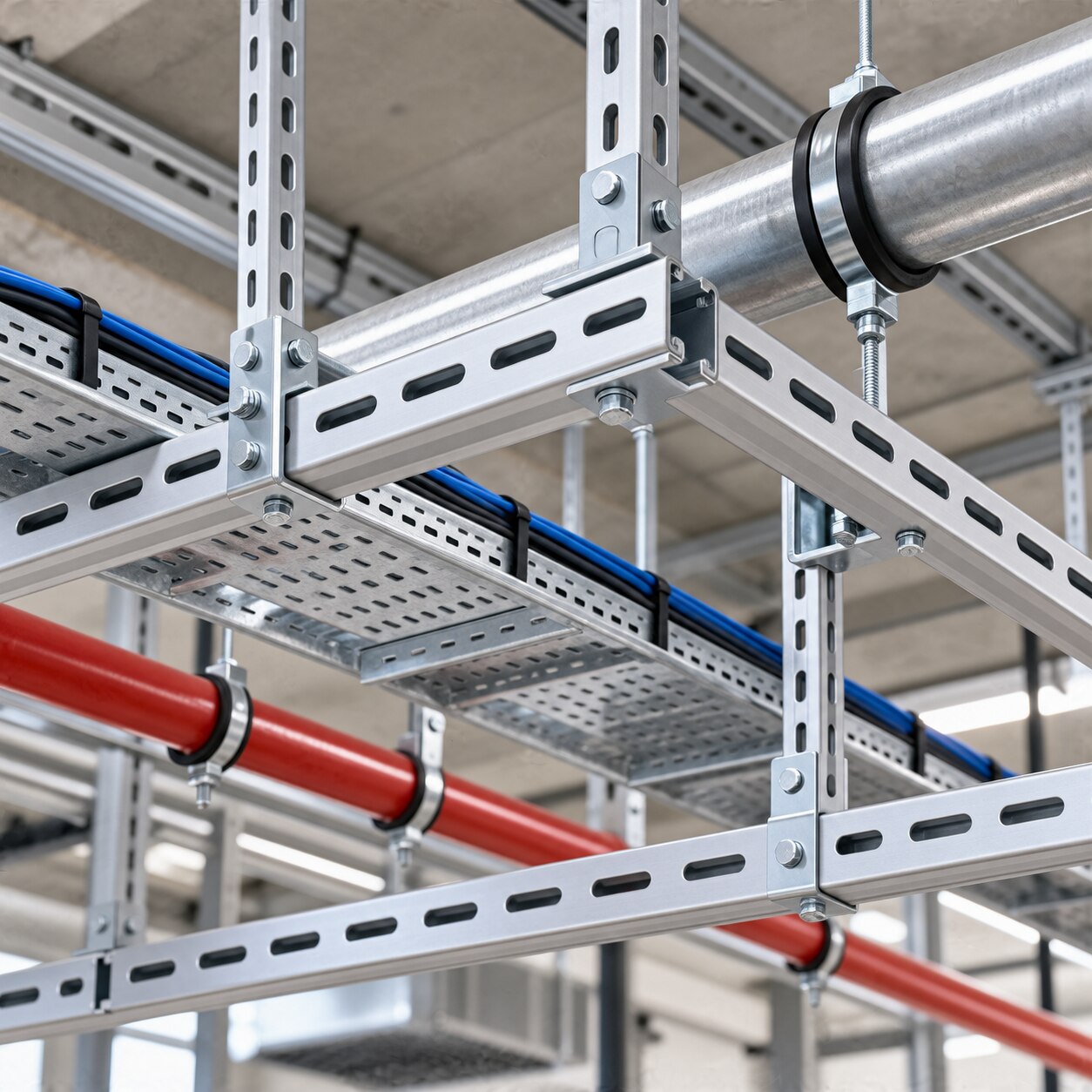
Aluminium wins when a machine reseller needs repeated changes more than maximum stiffness. T-slot aluminium extrusion uses profile-specific T-nuts, corner brackets and internal connectors; roll-formed slotted strut channel uses spring nuts and channel fittings. Their slots, load paths and design assumptions differ, so “aluminium strut” is not a sufficient specification.
| Option | Advantage | Limitation |
|---|---|---|
| T-slot aluminium extrusion | Light, easy to carry, route cables through, cut, alter and repair; no welding, grinding or repainting | Lower stiffness and vibration damping than steel for equal geometry |
| Welded steel frame | Higher stiffness, stronger damping, greater tolerance of impact and heavy loads | More fabrication labour, heat distortion, grinding, painting and difficult alterations |
The aluminium strut profile benefits justify redesign when guarding, sensors, fixtures and panels move between several machine variants. Standardised profiles and fittings reduce assembly labour and make replacement around mounted components faster. That is the practical machine frame profile benefits—not merely a lower frame weight.
Choose steel for high-vibration cutting machines, heavy gantries, long unsupported spans, high-impact loading, high-temperature zones or welding areas exposed to sparks. Coolant, cutting oil, abrasive dust and washdown can collect in open slots; anodising improves surface durability and appearance, but it does not seal slots or prevent galvanic corrosion.
Use covers, drainage, compatible hardware or another frame architecture where contamination matters.
Aluminium is the wrong choice when stiffness, damping or impact resistance dominates. It is worth choosing when modularity and service speed dominate.
How do you choose a profile for load, span and motion accuracy?
Choose by section properties, not the outside size printed in a catalogue. Ask the supplier for Ix and Iy, section modulus, mass per metre, alloy, temper and profile dimensional tolerances; two 40 mm profiles can have very different stiffness because their walls and internal webs differ.
Calculate the static load from panels, doors, control boxes, linear axes, tooling and moving masses. Then check cantilever length, unsupported span, joint spacing and dynamic acceleration.
Aluminium carries substantial loads, but strength is not the same as stiffness. Its elastic modulus is about 69 GPa, compared with about 200 GPa for steel.
| Material | Main risk | Design implication |
|---|---|---|
| Aluminium | Lower stiffness for equal geometry | A rail, ballscrew, spindle or inspection system can misalign from deflection |
| Steel | Greater stiffness and damping | Better for severe vibration, but heavier and less modular |
For the aluminium strut profile benefits for machine builders to hold, increase profile height, pair members, shorten the unsupported span, add intermediate supports or use triangulation before selecting a stronger alloy. If raw extrusion cannot meet alignment requirements, mount rails and ballscrews on machined datum plates, machined faces or accurately located subframes.
On long frames, allow for thermal expansion from Coimbatore workshop temperature changes. Establish one fixed reference and let the opposite end move through a controlled allowance; otherwise a constrained frame can shift rail alignment as it heats.
Which joints, T-nuts and frame details determine rigidity?
Joint design often determines practical rigidity more than the extrusion. Build the modular aluminium profile on a flat reference surface; seat every bracket fully, maximise contact area, orient joints against the expected load and square the frame before final tightening.
| Option | Rigidity and serviceability |
|---|---|
| Corner bracket | Simple, visible and easy to retighten; use two brackets for a loaded corner or cantilever. |
| Internal connector | Clean exterior and better access for panels, but depends on accurate drilling and concealed fastener preload. |
| Anchor fastener | Strong direct connection for high loads; reserve access for tightening and replacement. |
| Gusset | Adds triangular stiffness and resists racking; check clearance for doors, guarding and cable carriers. |
Do not overtighten a T-slot: crushed slot lips reduce holding power. Do not rely on one small bracket for a loaded cantilever. Select M6 or M8 T-nuts from the slot width, core geometry and profile series, then match the bolt size, connector hardware, sensor mounts, panel fasteners and available accessories.
A nut from a similarly sized profile may not fit. Check that sliding nuts enter from the slot end before installing end plates or other obstructions.
Plan adjustment feet and levelling points before assembly. Reserve mounting faces for polycarbonate panels, doors, interlocks, guarding, sensors and control boxes. Use thread-locking compound only after checking aluminium and temperature compatibility; use prevailing-torque nuts where suitable. Provide retightening access and record torque or inspection intervals for joints exposed to vibration, door movement or thermal cycling.
What does the reseller gain beyond the first machine build?
Resale value improves when the buyer can add guarding, sensors or fixtures without welding; it does not improve merely because the frame is aluminium. Compare the complete job cost: profiles, connectors, T-nuts, brackets, panels, feet, machining, packing, assembly labour, design changes, spare parts and shipping volume.
| Factor | Modular aluminium | Commercial effect |
|---|---|---|
| Resale | Reconfigurable frame and interchangeable modules | Supports variants and upgrades |
| Delivery | Faster cutting, less welding, no grinding or painting | Shortens repeat-build lead time |
| Service | Cleaner cable routing and replaceable components | Reduces modification downtime |
| Cost risk | Extra hardware and assembly checks | Loses advantage on one-off heavy structures |
Cutting is quick, but measure, deburr, square, level, tighten and recheck every frame. Standardise a small internal range of profile series, connector types and panel interfaces; too many families expand inventory and destroy interchangeability.
- Create repeatable cut lists, connector bills of materials, assembly drawings, spare-part kits and interchangeable frame modules.
- Validate each finished frame by comparing diagonals, recording joint torque, checking flatness, measuring rail alignment, testing deflection under load, and trial-fitting doors, panels and guarding before installing motion components.
These machine frame profile benefits and aluminium strut profile benefits for machine builders repay the extra hardware when you build repeat variants and expect frequent after-sales changes. Choose welded steel for a one-off heavy structure where modularity cannot recover its added connectors, labour and shipping volume.
How should you qualify an aluminium profile supplier in Coimbatore?
A locally stocked profile still becomes a machine delay if its slot, fasteners or cut ends do not match your design. Before ordering, identify the profile family—T-slot extrusion is not roll-formed strut channel—then check cross-section, slot geometry, T-nut size, connector standard, cut length, end preparation, squareness, connector clearance and the complete working envelope.
Ask the aluminium profile supplier in Coimbatore for:
- Stock lengths, cut-length tolerance, extrusion dimensional tolerance, straightness, alloy, temper, finish, technical drawings and section properties.
- Matching brackets, connectors, T-nuts, protected hardware, replacement parts and lead time.
- Deburring or machining when an end must seat against a datum; cut-length tolerance and extrusion tolerance are separate specifications.
- Drainage details and compatibility with coolant, oil, abrasive dust and washdown.
Check these failure points before releasing the purchase order:
| Check | Accept only when | Failure prevented |
|---|---|---|
| Profile and hardware | T-nut, connector, bolt and insertion method belong to the same series | Misfit joints and inaccessible nuts |
| Cut ends | Length, squareness and connector clearance suit the drawing | Rail or panel misalignment |
| Safety and environment | Bonding point, drainage and protected hardware are documented | Earth faults, corrosion and contamination damage |
Anodising and T-slot joints do not guarantee electrical continuity. Specify a purpose-designed bonding point, toothed washer or bonding conductor, then verify it during the machine safety test. SSB INDUSTRIAL SOLUTIONS should be judged on matched systems, repeatable cuts, documentation and local replacement support—not catalogue breadth.
Choose aluminium when modularity, handling and service speed outweigh damping and ultimate stiffness; choose welded steel when load, vibration or environment dominates.
Related product
 | Aluminium Strut Profile ₹500 40 x 40 Profile 45 x 45 Profile 40 x 80 Profile 45 x 90 Profile M6 T-Nut M8 T-Nut View product → |
Frequently asked questions
When do aluminium strut profiles beat welded steel frames?
Choose aluminium profiles when you need modular assembly, repeated changes, faster builds or easier access. Choose welded steel when maximum stiffness, heavy loads or long unsupported spans dominate.
How do you choose a profile for load, span and motion accuracy?
Calculate the load path and allowable deflection, then compare profile section size, span, orientation and support spacing. Linear guides and other precision motion components require tighter deflection control than guards or worktables.
Which joints, T-nuts and frame details determine rigidity?
Use T-nuts matched to the slot, correctly sized corner brackets or internal connectors, close support spacing and triangulation where needed. Tighten fasteners to the supplier’s specified torque and prevent unsupported cantilevered joints.
What should you check before choosing an aluminium profile supplier in Coimbatore?
Check profile standards, slot and T-nut compatibility, cutting tolerance, straightness, stock availability, accessory range, drawings and technical support. Request samples or a documented load and deflection calculation for critical frames.
Keywords