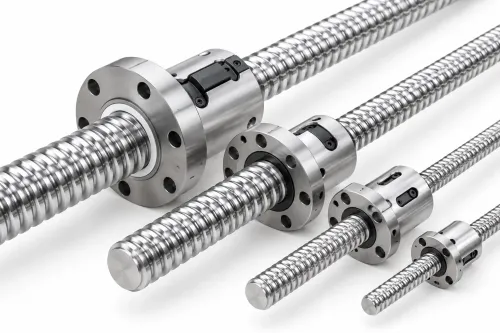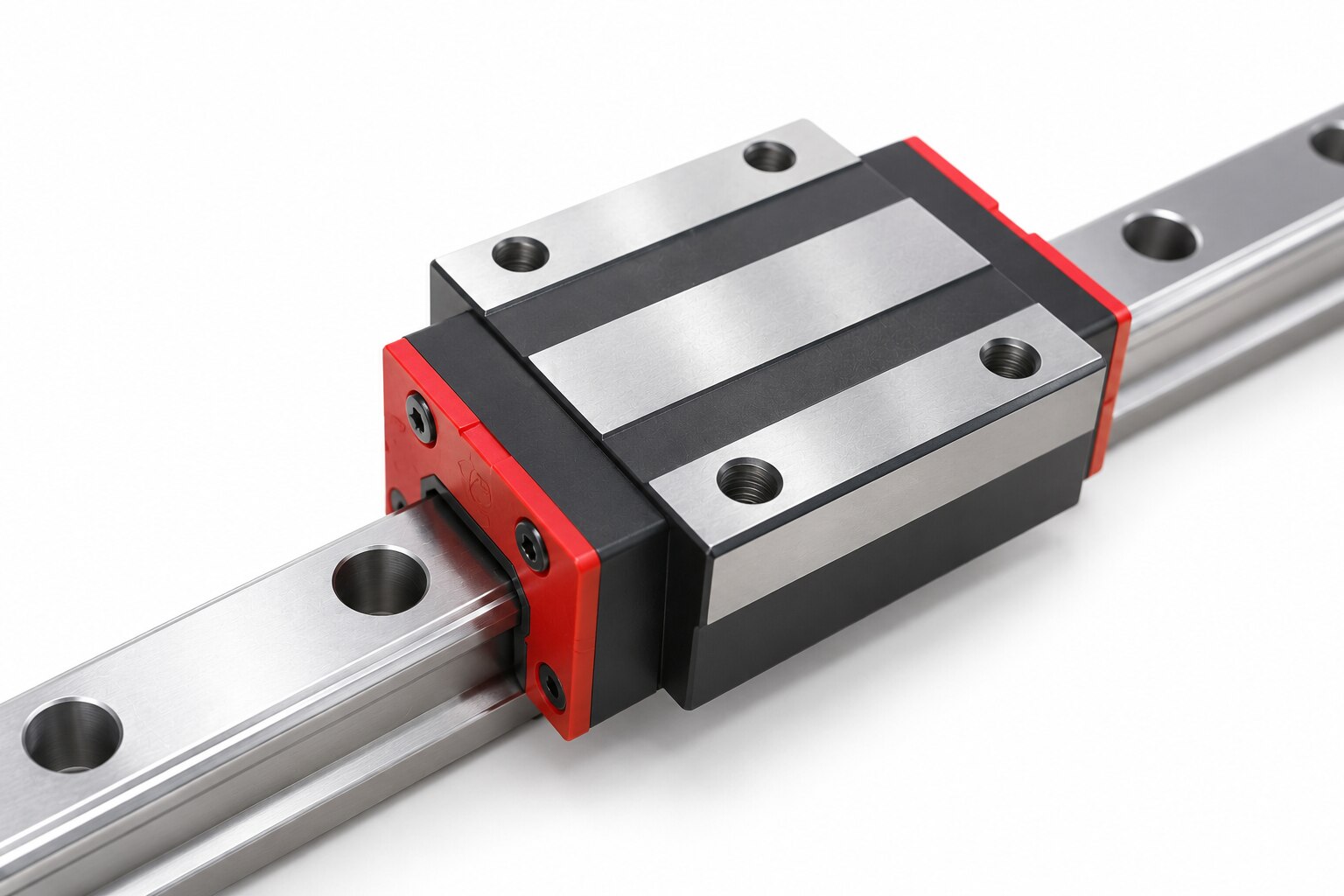
Stop the machine before forcing a tight carriage through its stroke. By isolating the drive, checking the guideway and mounting surfaces, and matching each symptom to a specific fault, you can decide whether the cause is contamination, misalignment, loading, lubrication, or a damaged component.
Key takeaways
- Lock out power and remove servo torque before testing the carriage.
- Inspect binding marks, rail seating, contamination, damaged seals, and raceway brinelling.
- Separate ballscrew, coupling, and external-load faults from guideway resistance.
- Match replacement carriage size, preload, accuracy class, and rail series exactly.
Isolate the binding before you adjust anything
Lock out power, support the axis, and remove servo torque before diagnosing a linear carriage binding fault. Do not jog through a tight spot: forced motion can brinell the raceways and damage balls, rollers, or seals.
- Remove the payload or separate the table from the external machine load if the design allows it. Mark the starting position, then move the carriage slowly by hand through the full stroke. Record whether resistance is constant, appears at one rail position, or changes with direction.
- If the carriage still binds while unloaded and disconnected from the drive, inspect the guideway, carriage, lubrication, contamination, and mounting. Chips on the raceways, dried grease, corrosion, damaged seals, displaced end caps, dents, or witness marks make the guideway the primary suspect.
- If hand movement is smooth, reconnect or test the drive train one part at a time. Rotate the ballscrew by hand where safe, check the coupling for angular or parallel misalignment, and test the actuator without the table or payload. A tight screw, damaged nut, dragging coupling, or skewed load points away from the rail.
- Compare the result under load. Resistance that increases sharply with payload indicates side loading, table distortion, or excessive preload rather than simple contamination.
A guideway carriage movement problem that appears only in the middle of travel demands measurement, not adjustment. Check rail parallelism and straightness over the full stroke with a dial indicator; do not force the carriage or assume a Coimbatore-specific shortcut overrides the manufacturer’s tolerances.
Read the binding pattern and inspect the physical evidence
Resistance that stays constant through the stroke points to seal drag, incorrect preload, dried grease, or contamination spread along the raceway. A tight spot that repeats at one rail position points instead to a rail defect, mounting distortion, or debris trapped at that location.
Do not force the carriage through it; brinelling the raceway can turn a recoverable fault into permanent damage.
| Pattern | Likely clue | Inspect |
|---|---|---|
| Constant drag | Seal friction, excessive preload, dry or incompatible grease | End-seal lip, lubricant condition, preload specification |
| Resistance rises with payload | Skewed carriage, side load, or excessive external moment | Table loading, mounting faces, carriage orientation |
| One fixed rail position | Dent, corrosion pit, chip, or rail seating error | Raceway and that rail station |
| Once per recirculation pitch | Damaged ball, roller, return path, or carriage raceway | End caps, recirculation path, dents and flaking |
| Changes with temperature | Grease viscosity, seal swelling, or clearance change | Specified lubricant, seal condition, ambient temperature |
Look for chips on the raceways, polished witness marks, displaced end caps, torn or swollen seals, loose mounting bolts, corrosion, and uneven grease. A seal that rubs over a rail defect can feel like a seized carriage; removing it sacrifices contamination protection and lubricant retention.
Move the carriage only with light hand force after cleaning loose debris. Record the guideway part number, preload, installation date, lubricant type, stroke, duty cycle, ambient contamination, and exact symptom.
This linear guideway carriage care record helps separate a recurring rail fault from a carriage that carries the roughness with it when moved to another rail.
Check rail seating, straightness, and parallelism
Verify rail alignment over the full stroke: a carriage that moves freely at both ends but tightens in the middle points to local rail straightness, parallelism, or mounting-surface error. Do not force it through the tight spot; that can brinell the raceways and damage balls or rollers.
- Disconnect drive torque and unload the table before checking alignment. Move the carriage by hand and mark the exact rail position where resistance rises.
- Establish one rail against the machine datum. Tighten its fasteners progressively, then use a dial indicator to measure the second rail’s lateral position against a reference carriage or calibrated gauge across the entire stroke.
- Check rail straightness with the indicator as the carriage travels. Use a precision straightedge and feeler gauge to find gaps beneath the rail or high spots on the mounting surface; loose bolts, chips, paint, and raised burrs can tilt the rail.
- Compare parallelism at several points, not just the two rail ends. Tighten both rails independently against a straightedge and the carriages can carry a large lateral load even when the rails look visually straight.
- If the carriage binds at one fixed rail position, inspect that location for dents, corrosion pits, flaking, witness marks, or a damaged seal. If realignment does not remove the resistance, suspect rail or carriage damage rather than servo tuning.
Record the measured deviation, rail position, fastener condition, preload, and lubricant in your linear guideway carriage care log. This evidence separates a guideway carriage movement problem caused by installation from one requiring component replacement.
Test the ballscrew, coupling, and external load separately
Lock out electrical and stored mechanical energy before separating the drive. Remove the payload, release the servo brake according to the machine procedure, and disconnect the servo coupling from the ballscrew. Do not force a tight carriage through its stroke; that can brinell the raceways and damage the balls.
1. Move the unloaded carriage by hand with the coupling disconnected. Binding that remains at the same rail position points to the guideway, table mounting, lubrication, contamination, or carriage—not servo tuning. A free-running carriage shifts suspicion to the ballscrew, coupling, or external load.
2. Rotate the ballscrew by hand through the full stroke with the motor disconnected. A repeating tight spot, roughness once per screw revolution, or changing torque indicates screw damage, contamination, a damaged nut, or poor screw support.
If the design permits, disengage the nut from the table and rotate the screw alone; this separates screw resistance from guideway resistance.
3. Inspect the servo coupling for cracked elastomer, loose hubs, displaced keys, and angular or parallel misalignment. Reconnect it without forcing the shafts together, then compare hand movement before and after tightening the coupling. A sharp increase identifies coupling alignment or installation stress.
4. Refit the table without the payload, then add the payload in stages. If resistance increases with load or changes when you support the table at different points, check table flatness, stiffness, load-centre height, and moment loading.
Record whether the linear carriage binding is constant, position-specific, load-dependent, or once per revolution. That pattern tells you which component deserves measurement next.
Clean, lubricate, and choose the correct replacement
Do not return the machine to service until the carriage moves smoothly by hand with drive torque removed. Wipe chips and old grease from the rail with a lint-free cloth, inspect raceways for dents, corrosion, brinelling, and witness marks, and check for displaced, torn, swollen, or rubbing end seals.
Never force a tight spot; that can damage balls and raceways.
Use the specified HIWIN lubricant, viscosity, quantity, and replenishment interval. Do not substitute penetrating oil or general-purpose spray, and do not mix greases unless thickener and additive compatibility are confirmed. Record these linear guideway carriage care details:
- Guideway and carriage part numbers, exact series and suffix
- Preload, accuracy class, flange type, seal arrangement, and installation date
- Lubricant type, stroke, duty cycle, contamination, temperature, and symptoms
- Whether resistance is constant, load-dependent, position-specific, temperature-dependent, or repeated at a recirculation pitch
| Binding pattern | Likely issue | Action before replacement |
|---|---|---|
| Constant drag | Contamination, dry grease, seal interference, or excessive preload | Clean, inspect the seal, lubricate correctly, then retest unloaded |
| One rail position | Rail damage or mounting error | Measure straightness and parallelism with a dial indicator; do not force the block |
| Worsens under load | Skew, non-parallel rails, or overloaded carriage | Check datum seating, mounting bolts, payload alignment, and preload |
| Repeated resistance | Raceway or ball damage | Remove the carriage for inspection rather than masking it with grease |
For hiwin carriage troubleshooting in coimbatore, match every recorded specification before ordering. Similar-looking blocks can differ in ball size, mounting dimensions, flange geometry, seals, preload, and accuracy. SSB INDUSTRIAL SOLUTIONS can use that identification record to prevent a bolt-on but incompatible replacement.
Treat linear guideway for carriage binding in coimbatore as a site-measurement problem, not a city-specific adjustment.
Related product
 | Hiwin Linear Guideway Linear guideways provides linear motion by re-circulating rolling elements between a profiled rail and a bearing block. View product → |
Frequently asked questions
How do you isolate a linear carriage binding problem safely?
Lock out power, support the axis, remove servo torque, and test carriage movement without forcing the axis through the tight spot.
What does the binding pattern reveal?
Binding at one position points toward rail damage, contamination, or local alignment error; resistance across the full stroke points toward preload, parallelism, or an external load.
How do you check rail seating, straightness, and parallelism?
Inspect mounting surfaces and fasteners, check rail straightness against the machine datum, and measure rail parallelism across the stroke before tightening the carriage system.
How can you separate ballscrew and coupling faults from guideway faults?
Disconnect or decouple the ballscrew where safe, then test the carriage and drive components separately to identify which assembly creates the resistance.
How do you choose a replacement linear guideway carriage?
Match the rail series, carriage size, flange or block style, preload, accuracy class, seal arrangement, and ball or roller type to the existing assembly.
Keywords