Choosing a rail by nominal width alone can leave an automation axis with excessive deflection, noisy running, premature wear or a block that does not match the existing rail. By the end, you will be able to narrow the HIWIN family, calculate the important loads, specify installation requirements and prepare a purchase description that can be checked against a machine drawing.
Key takeaways
- Size the rail after calculating carriage load, acceleration and overhang.
- Check static moments, dynamic load life and rail deflection before ordering.
- Match preload and accuracy to positioning needs, friction limits and drive type.
- Request rail length, carriage code, preload and accuracy class for replacements.
Choose the HIWIN family and rail size from the machine’s duty
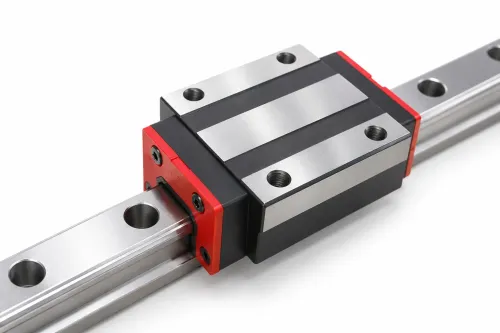
Select the HIWIN family by load direction, moment resistance, available height and motion speed; choose rail size only after checking carriage mass, acceleration and overhang. A wider-looking rail is not automatically stronger.
| Family | Form | Choose it when |
|---|---|---|
| HG | Square ball guideway | Standard automation axes need balanced load, stiffness and speed |
| EG | Low-profile ball guideway | The machine envelope limits block height |
| RG | Roller guideway | High stiffness, heavy loads or large moments dominate |
| MG or MGN | Miniature guideway | The carriage is compact and loads and moments are low |
| WE | Wide ball guideway | A broad mounting footprint improves moment capacity |
| QH or QE | Ball guideway variants | The required block geometry, load rating and mounting pattern match the machine drawing |
For hiwin linear guideway rails for industrial automation in Coimbatore, compare the catalogue load ratings and allowable moments for the complete block-and-rail combination, not the nominal rail width alone. Ball guideway rating life uses L10 = 50(C/P)³ km; roller families use a different exponent. Confirm static safety, deflection, duty cycle and contamination exposure before ordering.
Your specification for hiwin rails for automation machines must state the exact family, rail size and length, block type and length, block quantity per rail, preload, accuracy class, mounting orientation, rail joints and material or coating.
Match mounting-hole pitch, shoulder dimensions and datum faces to the existing drawing; similarly sized HG, EG, RG, MG and WE parts are not interchangeable.
Calculate load, moments, life and deflection before specifying the rail
Size the guideway from the worst combined load, not carriage mass alone. Calculate vertical force as (carriage mass + payload) × gravity, then add acceleration force, mass × acceleration, in the travel direction. An overhung payload creates moments: M = force × offset from the guideway plane.
- Record the mass, centre of gravity, overhang, acceleration, speed, stroke and cycle time. Include cutting force, cable drag and external loads; a nominal payload figure hides these forces.
- Resolve the two-rail arrangement into vertical, lateral and longitudinal forces. Check each block for the resulting load and overturning moment, because an offset carriage shifts load onto one block instead of sharing it equally.
- Calculate the dynamic equivalent load P using the HIWIN load-distribution method for the actual block arrangement. For ball guideways, estimate fatigue life with L10 = 50(C/P)³ kilometres; use the manufacturer’s specified exponent for roller guideways.
- Convert variable duty into an equivalent load using each load level and its time fraction. A short, heavy acceleration segment can govern life even when the average load looks harmless.
- Check static safety against the catalog static rating C0, then calculate rail and mounting deflection from catalog stiffness and support conditions. Excess deflection creates positioning error before fatigue failure appears.
Use the correct family’s ratings: RG roller guides suit higher stiffness demands, while HG, EG, MG and WE blocks have different moment limits despite similar nominal rail widths. In linear guideway rail applications, chips, coolant and abrasive dust also shorten life, so seals, covers and lubrication belong in the calculation.
Match preload and accuracy to positioning, friction and drive requirements
A high preload is not automatically better. Select the lowest HIWIN preload that achieves the calculated rigidity: extra preload removes clearance, but it also raises friction, heat and drive force, which can increase servo size and shorten practical life.
- Choose light preload for low-friction axes, long travel and modest positioning loads.
- Choose medium preload when the carriage sees changing loads or moderate cutting and handling forces.
- Choose high preload only when measured deflection, vibration or moment stiffness demands it; confirm the resulting starting force against motor torque.
- Select accuracy class from the machine result, not the catalog maximum. Normal or high accuracy may suit transfer axes, while precision, super-precision or ultra-precision grades require tighter datum surfaces and alignment control to deliver their value.
- Use two blocks per rail when overhang or pitching moment requires a longer support span. Do not add blocks solely for nominal capacity; each block increases alignment sensitivity and running resistance.
- Specify the rail size, block type, preload, accuracy class, block count per rail, mounting orientation and any joined-rail requirement.
For linear rails for machine builders, mount one rail against a controlled datum shoulder and align the companion rail to it; tightening both rails against an inaccurate base will bind the carriage. Follow the HIWIN bolt sequence and verify parallelism, block height and smooth resistance across the full stroke before final tightening.
On a joined rail, stagger or position joints as shown in the assembly drawing and check the block crossing each joint for impact or periodic drag.
Install rails against controlled datums and protect them from the process
A rail runs true only when its datum shoulder, supporting surface and parallel partner are controlled before tightening. A poor base can make a precision guideway perform worse than its catalogue accuracy; contamination then turns small alignment errors into rough running and premature wear.
- Machine the mounting surfaces and verify flatness with a straightedge, precision level or indicator. Remove burrs, paint, chips and raised spots from the rail seat and datum shoulder.
- Seat the reference rail firmly against its datum shoulder, then tighten its bolts from the centre outward in the drawing’s sequence. Use the specified torque and recheck running resistance after fastening.
- Set the second rail parallel to the reference rail with an indicator on the carriage. Do not force the block across misaligned rails; it loads the raceways and increases drive torque.
- Apply the HIWIN-recommended grease or oil through an accessible port, then establish a relubrication interval from travel, speed, load and contamination. Too little lubricant accelerates wear; excess grease attracts abrasive dust.
- Seal the guideway from chips, coolant, abrasive dust and dried residue with the correct end seals, wipers, scrapers, bellows or covers. In linear guideway rail applications, keep the raceway covered during cutting, grinding and washdown.
For HIWIN rails for automation machines in Coimbatore, inspect seals after installation and keep the guideway away from direct coolant spray. Add drainage and shielding where humidity, condensation or process liquid can remain on the rail. A clean, protected rail needs less corrective maintenance.
Specify a matched replacement and compare supplier quotations correctly
Give a HIWIN rail supplier in Coimbatore the complete guideway specification, not the phrase “HIWIN linear rail.” Send the existing part code, machine drawing and these details:
- Series and size, such as HG or RG 25
- Rail length, quantity of rails and block type
- Number of blocks per rail and mounting orientation
- Preload and accuracy class
- Complete matched-set requirement, or permission to quote rails and blocks separately
- Joint positions, rail-end matching and block travel direction for a long axis
- Existing rail datum, shoulder dimensions and mounting-hole pitch
Ask SSB INDUSTRIAL SOLUTIONS to mark each quotation against the drawing, because a nominally identical size can still have different block height, hole spacing, preload or accuracy.
| Quote basis | What to verify | Why it matters |
|---|---|---|
| Complete matched set | Rail, blocks, preload and accuracy supplied as one specified combination | Prevents excess running resistance, height mismatch and poor parallelism |
| Individual components | Exact rail and block codes listed separately | A cheaper block is not interchangeable because the rail size matches |
| Joined rail assembly | Section lengths, joint locations and end matching shown | A badly aligned joint causes periodic resistance, vibration and impact |
| Alternative grade | Series, dimensions, preload and accuracy compared line by line | “Equivalent” does not prove fit |
Do not treat the supplier’s quotation as proof that the base is suitable. Check the rail shoulder, supporting-surface flatness, parallelism and bolt sequence against the installation drawing; linear rails for machine builders cannot compensate for a distorted mounting surface.
Related product
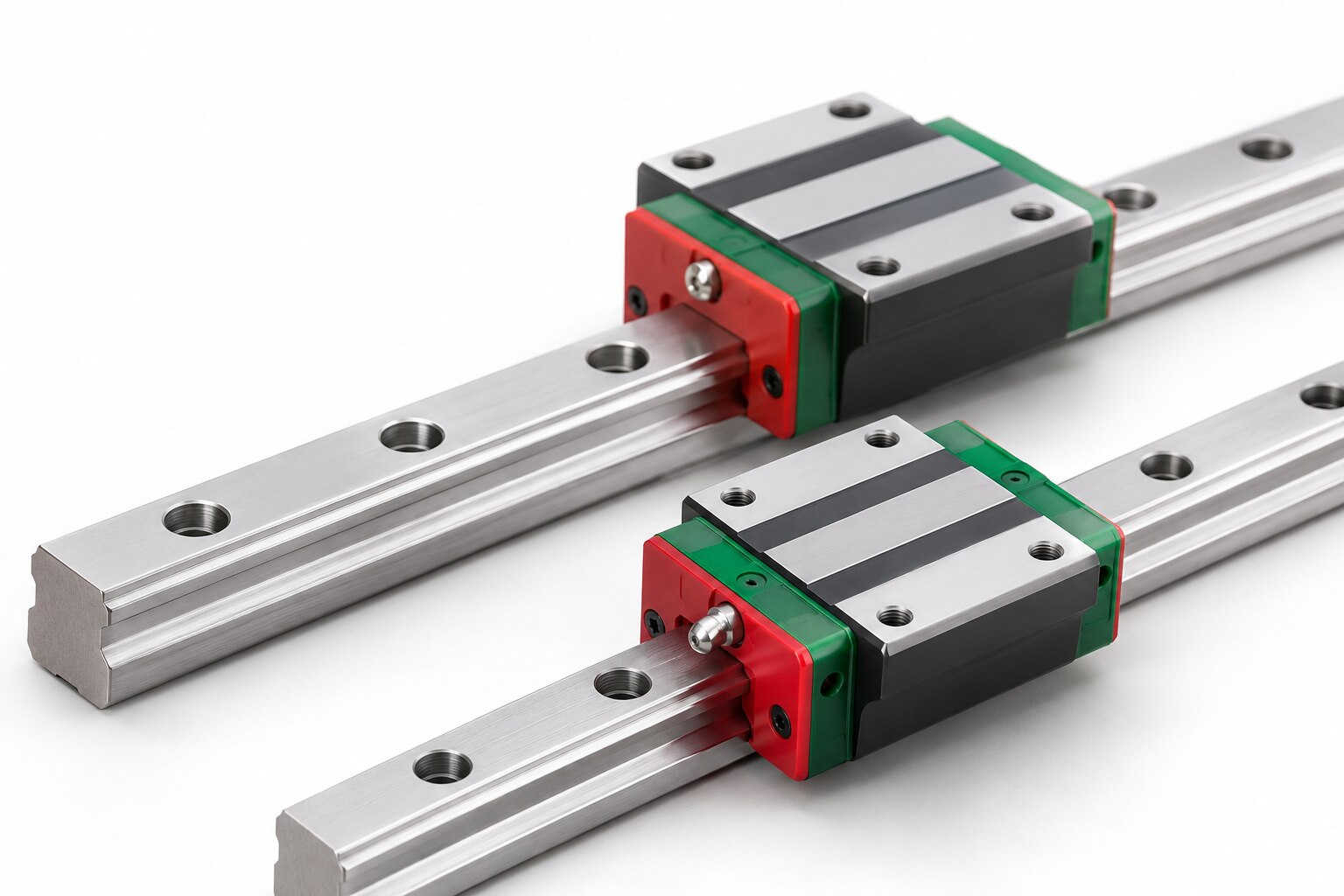
 | Hiwin Linear Guideway Linear guideways provides linear motion by re-circulating rolling elements between a profiled rail and a bearing block. View product → |
Frequently asked questions
How do you choose a HIWIN family and rail size?
Start with load direction, moment resistance, installation height and speed. Then calculate carriage mass, acceleration, overhang and applied loads before selecting the rail size.
What calculations are needed before specifying HIWIN linear guideway rails?
Check dynamic load rating, static safety factor, pitch and yaw moments, expected life and deflection under the machine’s actual loads and acceleration.
How should preload and accuracy be matched to an automation machine?
Select preload for stiffness and vibration control without adding unacceptable friction, then choose accuracy according to positioning tolerance, drive resolution and repeatability requirements.
What information is needed to replace an existing HIWIN rail?
Record the family, rail size, rail length, carriage type, number of carriages, preload, accuracy class, mounting-hole pattern and reference datums before comparing quotations.
Keywords