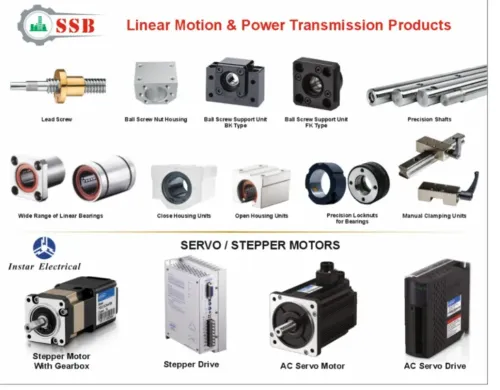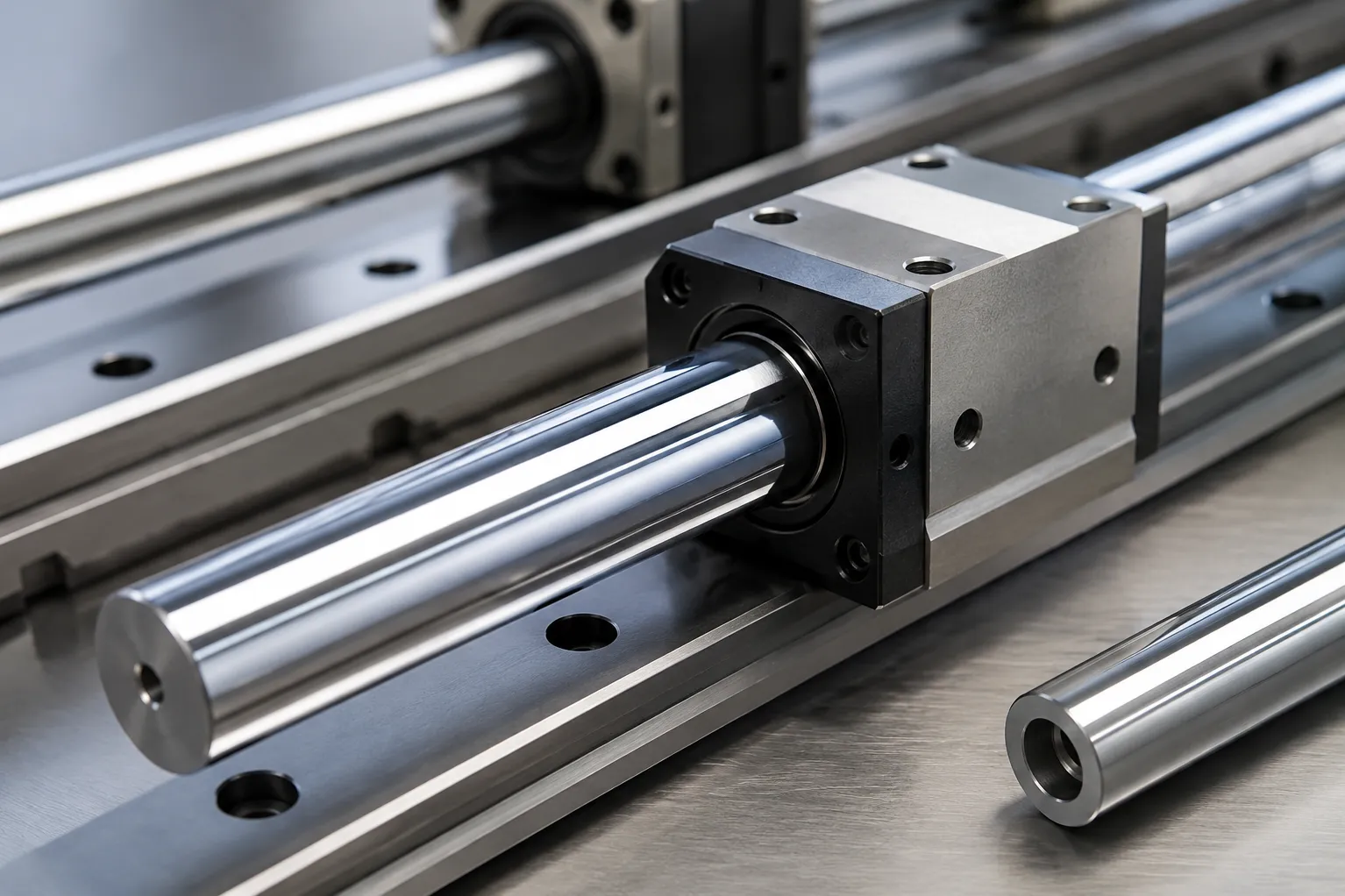
Many industrial machines require a simple, durable method of guiding linear movement. In applications using supported or unsupported round-shaft arrangements, a Hard Chrome Shaft for Linear Motion Systems can provide the running surface required by compatible linear bearings and motion components.
The concept may appear straightforward, but shaft quality, diameter, straightness, surface condition and installation all influence actual machine performance.
What Is a Hard Chrome Shaft?
A hard chrome shaft is typically an accurately manufactured steel shaft with a hardened or hard-chromed working surface designed to provide suitable wear characteristics.
When paired with compatible linear bearings, the shaft acts as the guide along which the bearing assembly travels.
These shafts can be found in equipment such as:
- Packaging machinery
- Assembly equipment
- Material-transfer mechanisms
- Special-purpose machines
- Printing and processing machinery
- Light automation systems
- Industrial fixtures
The exact suitability depends on loading, support arrangement and operating environment.
Why Surface Condition Is Important
The shaft is the running surface for the bearing.
Surface irregularities, corrosion, damage or contamination can therefore influence movement and bearing life. A controlled surface finish helps rolling elements operate consistently along the shaft.
For procurement teams, this means that shaft selection should go beyond checking only nominal diameter and overall length.
Material characteristics, surface hardness, dimensional tolerance and straightness may all be relevant to the application.
Supported and Unsupported Arrangements
An unsupported shaft is mounted primarily at its ends. As span and loading increase, deflection can become an important design consideration.
A supported shaft receives additional structural support along its length, which can increase rigidity in applications where deflection needs to be controlled.
Neither arrangement is universally better.
The appropriate design depends on:
- Shaft span
- Applied load
- Required rigidity
- Available mounting space
- Machine construction
- Desired travel
- Accuracy expectations
Calculating or evaluating shaft deflection before finalizing a machine can prevent performance problems later.
Alignment Is Just as Important as Shaft Quality
Using a precision shaft does not guarantee smooth movement if the installation is poorly aligned.
Parallel shafts must be positioned carefully. Misalignment can increase bearing resistance, produce uneven loading and create binding during travel.
The mounting structure should therefore be sufficiently rigid and accurately prepared.
Installation practices become particularly important when two shafts and multiple bearings are used to support a common moving platform.
Protecting the Shaft in Industrial Environments
Coimbatore's manufacturing ecosystem includes textile machinery, machining operations, foundry-related industries and general engineering environments where dust and process contaminants may be present.
Contamination on exposed shaft surfaces can affect the motion assembly.
Depending on the machine, designers may consider:
- Bearing seals
- Protective covers
- Regular cleaning
- Suitable lubrication
- Bellows or guarding
- Strategic component placement
Environmental protection should be treated as part of the original design rather than an afterthought.
Selecting a Shaft for the Application
SSB Industrial Solutions serves industrial buyers and engineering teams evaluating linear-motion components for equipment in Coimbatore and across Tamil Nadu.
When discussing a Hard Chrome Shaft for Linear Motion Systems, useful selection information includes shaft diameter, required length, load, support method, operating environment and compatible bearing arrangement.
For replacement applications, details of the existing shaft and bearing can also help avoid dimensional mismatches.
Round-shaft linear systems remain useful because they can provide practical linear guidance for many industrial mechanisms. Their effectiveness, however, depends on selecting the shaft as part of a complete motion arrangement.
When diameter, support, bearing compatibility, alignment and environmental conditions are evaluated together, the resulting system is more likely to provide the controlled movement the machine was designed to achieve.
Keywords