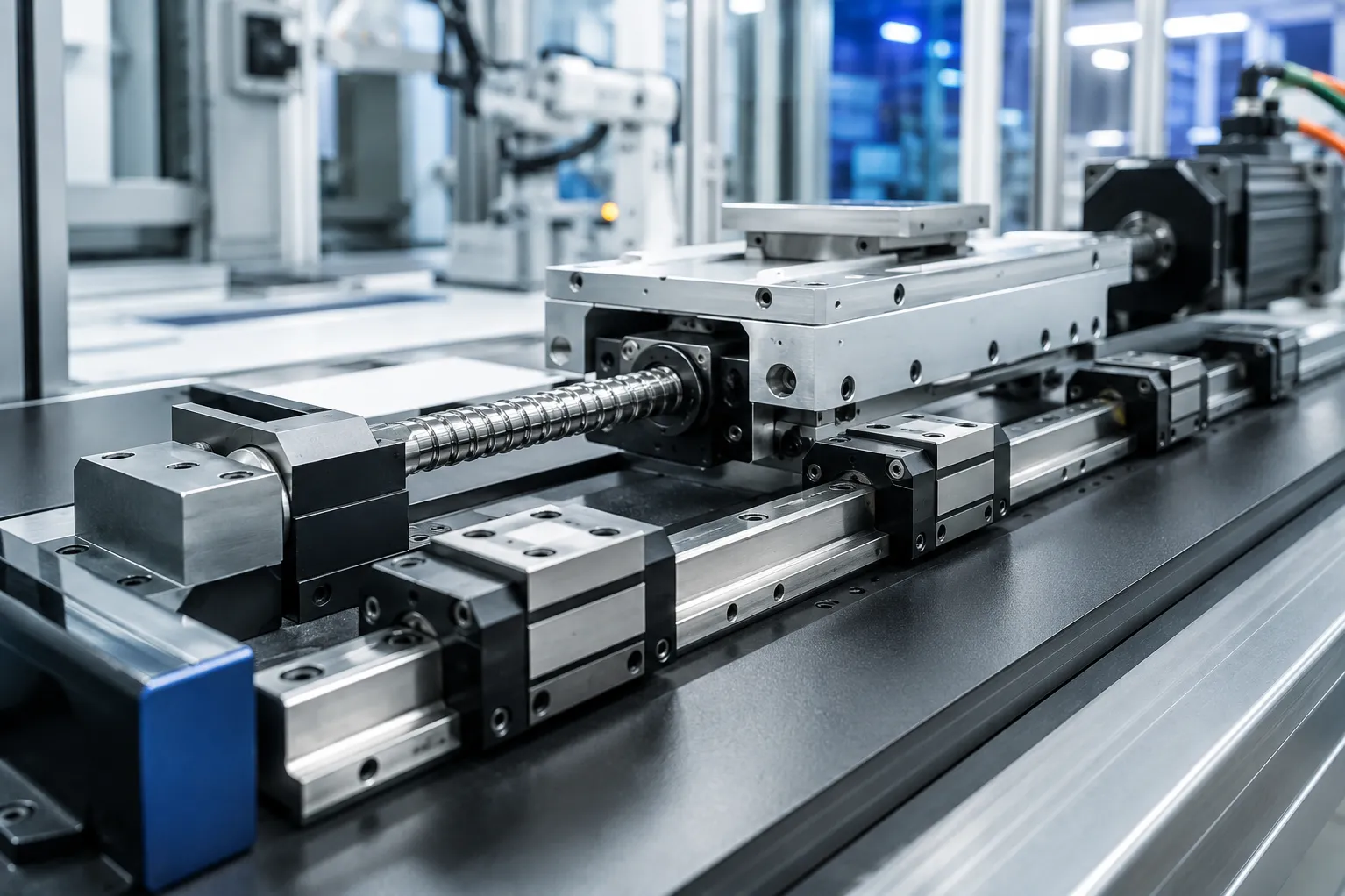
Modern automated machinery depends on controlled, repeatable movement. Whether the equipment is used for CNC machining, assembly, packaging, inspection, material handling or component manufacturing, the quality of linear motion directly affects machine performance. This is where Linear Guideway Rails for Industrial Automation play an important role.
Linear guideway rails provide a structured path along which a carriage or runner block can move with low friction. Unlike basic sliding arrangements, properly selected guideways are designed to support loads while maintaining controlled linear movement.
For machine manufacturers and automation integrators in Coimbatore and across Tamil Nadu, understanding guideway selection can help prevent premature wear, positioning problems and unnecessary maintenance.
What Does a Linear Guideway Rail Do?
A linear guideway generally consists of a precision rail and one or more matching blocks. Rolling elements inside the block circulate as it moves along the rail, helping reduce friction while supporting the applied load.
This arrangement can be useful where machinery requires:
- Smooth linear travel
- Consistent positioning
- Load-carrying capability
- Controlled movement at varying speeds
- Repeatable machine cycles
- Reduced friction compared with conventional sliding systems
The required rail size and configuration depend on the actual machine rather than simply the length of travel.
Why Load Direction Matters
One common mistake is selecting a guideway primarily by physical dimensions.
Machine loads may act vertically, horizontally or through moments generated by an offset load. Acceleration, deceleration and changing operating conditions can further influence the forces experienced by the guideway.
An industrial engineer therefore needs to consider static load, dynamic load, moment loads and the arrangement of multiple blocks before finalizing the system.
A guideway that appears adequately sized based on machine weight alone may not necessarily suit the forces produced during operation.
Accuracy Requirements Should Match the Application
Not every industrial machine needs the same level of positioning accuracy.
A high-precision inspection or machining system can have substantially different requirements from a general-purpose transfer mechanism. Selecting unnecessarily high specifications may increase costs without creating meaningful operational value.
Conversely, insufficient rigidity or accuracy can affect finished component quality and machine repeatability.
The practical goal is to match guideway characteristics to the required motion profile and machine function.
Installation Conditions Influence Performance
Even a correctly selected guideway can perform poorly when the mounting surfaces are not prepared properly.
Rail alignment, mounting surface flatness, bolt tightening sequence and contamination protection can influence service life and movement quality. Designers should also consider lubrication access before the machine structure is finalized.
In manufacturing environments where dust, chips, coolant or process debris may be present, suitable sealing and protective arrangements become particularly important.
Think About the Entire Motion System
A linear guideway should not be evaluated independently from the rest of the machine.
Its performance interacts with components such as:
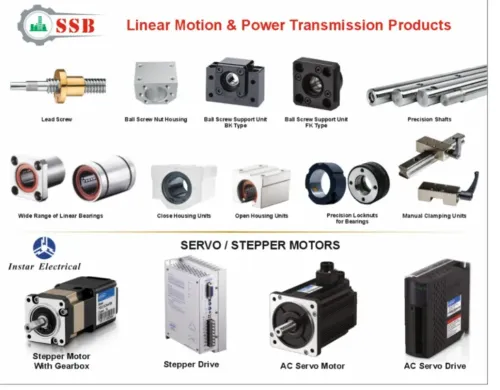
- Ball screws
- Motors and drives
- Couplings
- Gearboxes
- Machine frames
- Sensors and limit switches
- Lubrication systems
For example, specifying a precision guideway will not compensate for excessive structural deflection or an incorrectly selected drive mechanism.
Selecting Guideways for Coimbatore's Manufacturing Sector
Coimbatore has a diverse engineering base covering machine tools, pumps, textile machinery, automotive components, special-purpose machines and industrial automation. These applications can create very different linear-motion requirements.
SSB Industrial Solutions supports industrial customers evaluating motion components for machinery and automation applications in Coimbatore. A useful technical discussion should begin with the application rather than only a requested part number.
Before selecting a guideway, procurement and engineering teams should ideally establish the travel length, load, operating speed, mounting orientation, expected duty cycle, environmental conditions and required accuracy.
When these factors are considered together, Linear Guideway Rails for Industrial Automation can become an integral part of a reliable motion architecture rather than simply another mechanical component on the bill of materials.
Keywords